

Overview
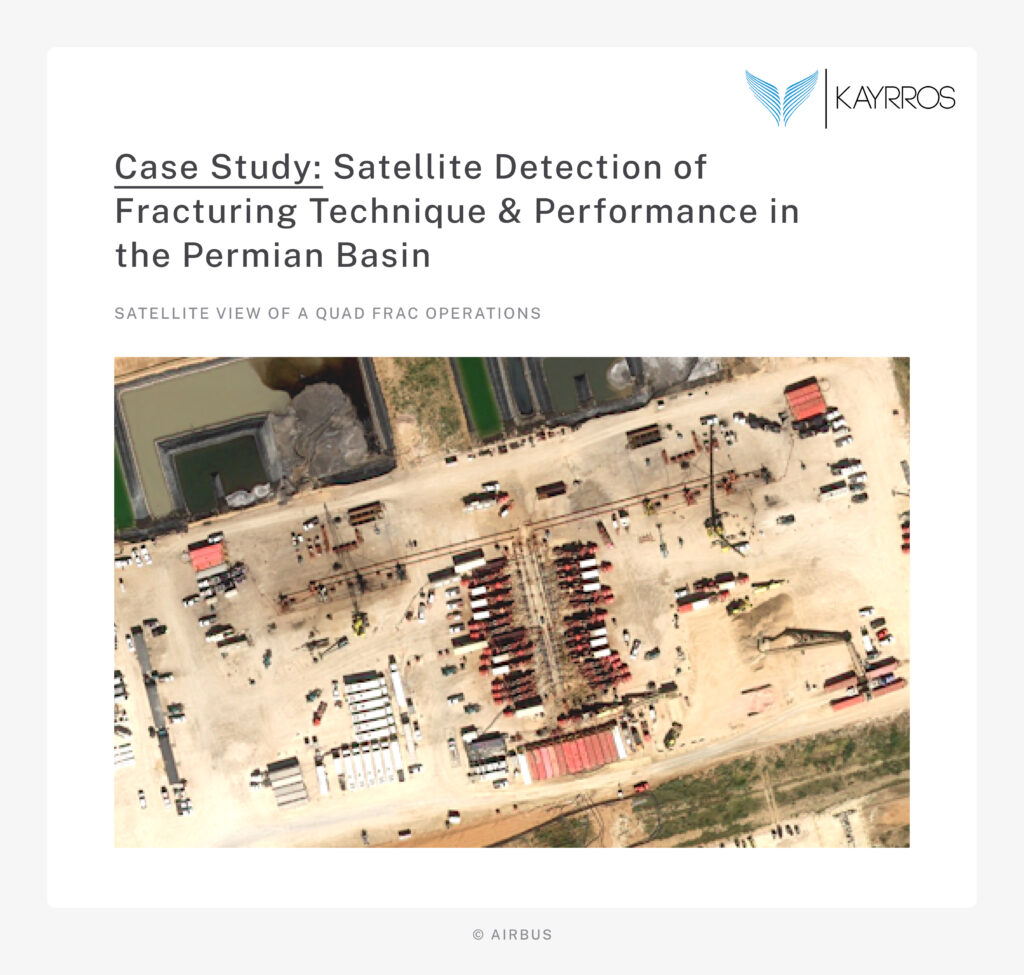
The advancements of simultaneous operations is not necessarily a novelty in the oil and gas industry, in both offshore and land we have been doing simultaneous drilling, completing, workover. But a new trend in frac operations has significantly put the concept to a test. In conjunction with our customers, we have recently noticed a significant jump into frac footage performance which led us to further investigate what was happening on the ground. Using satellite high-resolution imagery to better understand what was going on and drawing on hundreds of satellite images, expert input, and proprietary analytical methods, Kayrro’s team evaluated more than 553 wells across 110 different pads over a three-month period to detect what fracking technique has been used and how this correlated with fractured footage per day performance.
Key Insight
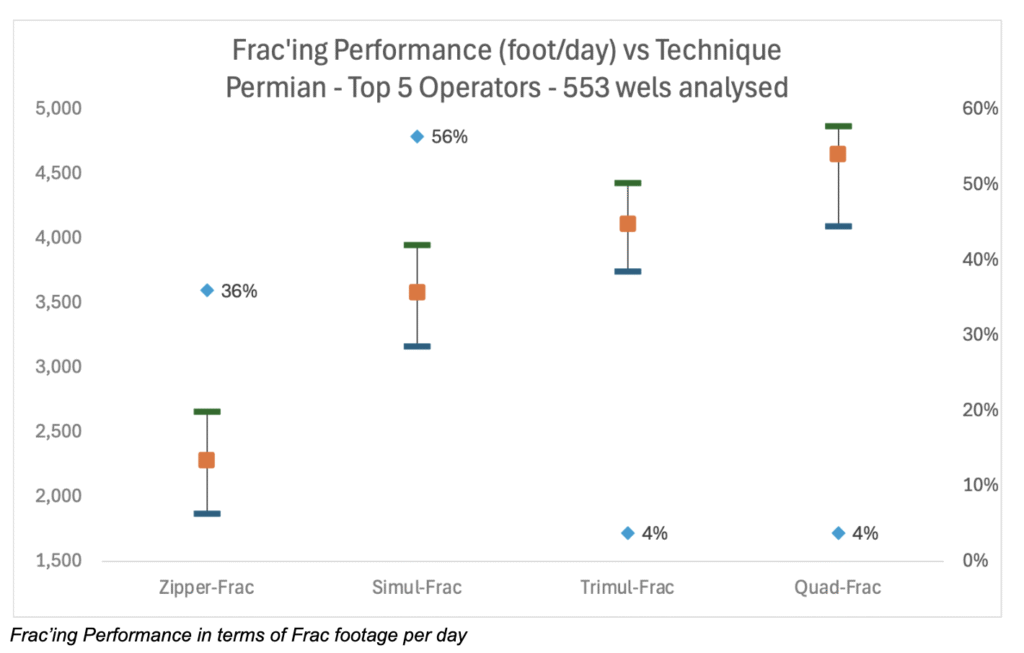
Operators employing trimul-frac and quad-frac techniques—simultaneously stimulating 3 to 4 four wells—achieved more than double the average footage fractured per day compared to traditional zipper frac’ing (one well at a time). Yet despite the clear advantages, adoption remains nascent: less than 10% of wells among the top five operators utilized trimul or quad frac techniques, while simul frac (two wells) is now more commonly observed than zipper frac’ing—with 56% wells having simultaneous frac’in operations versus 36% for zipper.
Technical Description & Findings
- Data Collection: We uniquely combined satellite imagery with domain expertise and client validation to detect fracking styles—looking at pumping gear, crane counts, sand-mixing setups, and pad arrangement.
- Detection Approach: Each pad was analyzed by oilfield experts and matched with ground-truth insights from our client base to reliably classify whether a pad was using zipper, simul, trimul, or quad frac.
- Scale & Scope: Over 553 wells on 110+ pads during 3 months were assessed, offering both breadth and granularity.
- Performance Outcomes:
- Zipper frac (1-well): baseline speed averaging 2300ft/day
- Simul frac (2-well): modest speed gains; now most common (~56%)
- Trimul frac (3-well) und Quad frac (4-wells): dramatic uplift—roughly 2× average footage greater than zipper, up to ~4× at the lower bounds
Adoption Trends: Despite efficiency gains, advanced techniques (trimul/quad) remain limited (<10% adoption), suggesting untapped potential.
Why This Matters
- For E&P Analysts: Understanding the correlation between fracking technique and throughput helps refine performance modeling and benchmarking.
- For Investors & Traders: Rapid shifts in completion performance—especially when triggered by adoption of advanced frac methods—can inform near-term supply expectations.
- For E&P Operators: Insights on technique performance empower better execution decisions—unlocking a faster route to production and cost efficiency.
Conclusion
This analysis showcases how combining satellite imagery, AI-enabled detection, and field expertise can surface game-changing insights on fracturing technique and performance—without deploying boots on the ground. As the industry embraces more complex, multi-well stimulation, operators who lead in adoption are poised to gain outsized margin and pace advantages. Kayrros clients now have the tools to continuously monitor these dynamics, uncover innovation early, and optimize execution.
How to Access the Frac Landscape Dataset
Since Q3 2025, the Kayrros team has made Frac Landscape available as an optional dataset within the E&P Intelligence product suite. This enhancement allows users to view, at the well level, the specific fracturing technique applied to each completion. With this information, operators and traders can monitor the adoption of simultaneous frac operations and analyze how quickly these advanced techniques are spreading across basins.
The dataset also enables direct correlation between frac type, well productivity, and key performance indicators such as cycle time and completion efficiency. If you are interested in gaining access to this dataset, please contact your Kayrros account representative for additional details.
References: https://jpt.spe.org/shale-evolution-zipper-fracture-takes-hold
About Kayrros:
Kayrros is the world leader in energy and environmental intelligence. It uses AI and geoanalytics to turn raw satellite data into actionable insights on energy, supply chains, physical risks, nature and the environment, working with businesses and governments to make energy systems more efficient, improve supply security, boost climate resilience, and manage environmental impacts while enabling investors, insurers, traders and other stakeholders to make faster, smarter decisions.
For more information visit www.kayrros.com or contact r.guedesdecarvalho@kayrros.com to learn more about our E&P Intelligence products.